

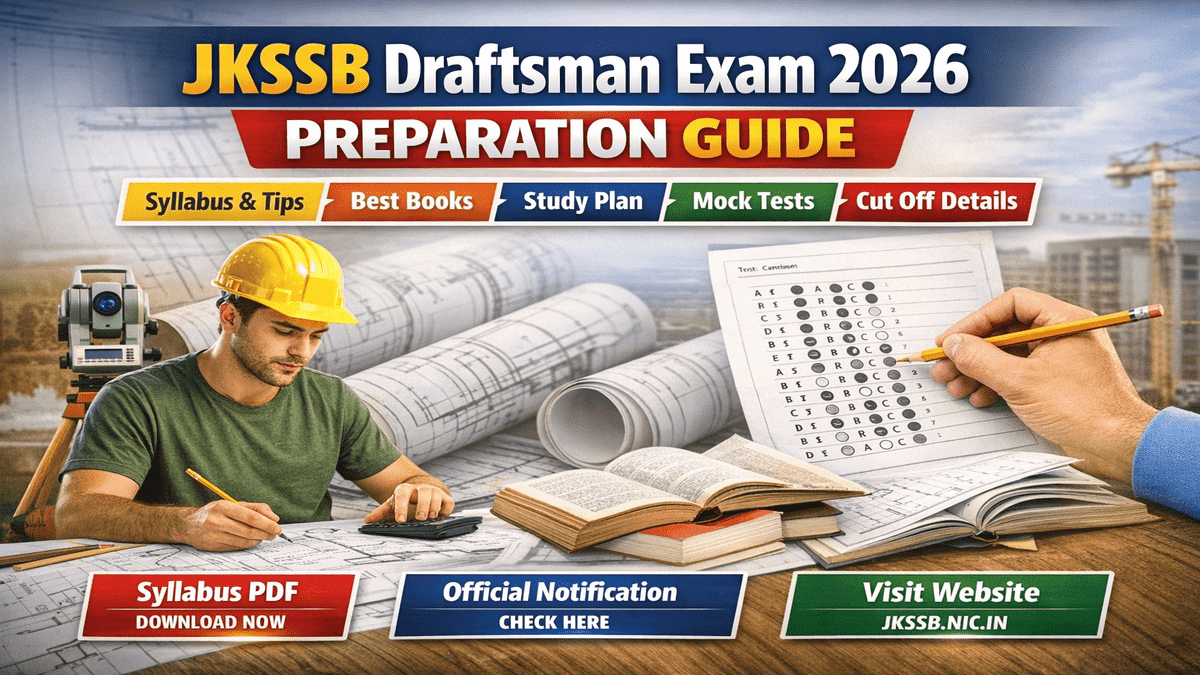
The Jammu and Kashmir Services Selection Board (JKSSB) has released a recruitment notification for 76 vacancies. Following the issuance of this advertisement, applications can be submitted starting from April 15, 2026. The selection process for these positions is highly streamlined, consisting solely of a written examination, followed by document verification, after which candidates will be recruited for the job. The age limit for applicants ranges from 18 to 40 years. Regarding remuneration, the salary offered is expected to fall between ₹25,000 and ₹80,000, depending on the specific level of the position.
hile many individuals have already become aware of this notification, we have provided a detailed explanation here regarding how to prepare for the exam, the specific syllabus topics to expect, which books to consult, and the optimal strategies to adopt—information that will prove immensely valuable for your career. If you are a complete newcomer to this process and have applied for the position,
you are strongly advised to review the syllabus and all other details provided below, as these cover critical topics essential for your preparation. Additionally, the official syllabus notification has been released by the authorities; we have provided a direct link below, allowing you to download the PDF and review the syllabus in its entirety.
JKSSB Draftsman Recruitment 2026 Overview
| Particulars | Details |
|---|---|
| Organization Name | Jammu & Kashmir Services Selection Board (JKSSB) |
| Post Name | Draftsman (Civil) |
| Advertisement Number | 02 of 2026 |
| Total Vacancies | 76 Posts |
| Department | Jal Shakti Department |
| Application Mode | Online |
| Start Date to Apply | 15 April 2026 |
| Last Date to Apply | 14 May 2026 |
| Selection Process | Written Examination + Document Verification |
| Job Location | Jammu & Kashmir |
| Pay Scale | ₹25,500 – ₹81,100 (Level-4) |
| Age Limit | 18 to 40 Years |
| Official Website | jkssb.nic.in |
JKSSB Junior Assistant Admit Card 2026 Download Guide, Direct Link & Important Instructions
JKSSB Draftsman Exam Pattern 2026
| Particulars | Details |
|---|---|
| Mode of Exam | Objective Type (OMR Based / CBT) |
| Type of Questions | Multiple Choice Questions (MCQs) |
| Total Questions | 120 Questions (Expected) |
| Total Marks | 120 Marks |
| Duration | 2 Hours |
| Negative Marking | Yes (0.25 Marks Deducted for each wrong answer) |
| Subjects Included |
Technical Subjects (Surveying, Mechanics, Soil Engineering, Hydraulics, Construction Planning, Water Supply, Irrigation, Engineering Drawing, Environmental Laws) |
JKSSB Draftsman Syllabus 2026
Surveying
- Importance & principles of surveying
- Classification of surveying
- Measurement of distance & directions
- Chain Surveying
- Compass Surveying
- Leveling
- Tacheometry
- Theodolite
- Traversing
- Contouring
- Plane Table Surveying
- Curves
Mechanics & Structural Analysis
- Concept of rigid body
- Scalar & Vector quantities
- Laws of forces
- Moment & friction
- Centre of gravity
- Simple machines
- Torsion
- Properties of materials
- Bending moment & shear force
- Stress & strain relationship
- Principal stresses & stress transformation
- Bending theory (flexural & shear stresses)
- Unsymmetrical bending
- Shear centre
- Thin walled pressure vessels
- Buckling of columns
- Combined stresses
- Slope & deflection
- Trusses analysis
Modern Tools & Technologies
- GIS (Geographical Information System)
- Remote Sensing (RS) Applications
Soil Engineering / Fluid Mechanics & Hydraulics
- Origin & classification of soils
- Soil properties & relationships
- Permeability & seepage
- Effective stress principle
- Properties of fluids
- Hydrostatic pressure
- Measurement of pressure
- Flow through pipes & open channels
- Hydraulic pumps
- Conservation laws (mass, momentum, energy)
- Bernoulli’s equation
- Potential flow
Construction Planning & Management
- Network diagrams
- PERT & CPM
- Cost optimization
- Contracts & tenders
- Depreciation & valuation
- Measurement book & cash book
- Functions of management
- Construction planning
- Quality control
- Inventory control
- Estimation & costing
- Types of estimates
- CAD programs
Water Supply & Waste Water Engineering
- Water demand & quality
- Water treatment
- Conveyance of water
- Pipe laying
- Building water supply system
- Plumbing & fixtures
- Sewerage system
- Sewage characteristics
- Methods of disposal
- Sewage treatment
- Building drainage
- Air & noise pollution
- Pumps (centrifugal, reciprocating, diaphragm, pneumatic)
- Pumping stations
Environmental Legislations in India
- Environment Protection Act 1986
- Environmental Impact Assessment (EIA) 2006
- Water Act 1974
- Air Act 1981
Irrigation Engineering
- Water requirement of crops
- Hydrological cycle
- Dams & canals
- Canal head works
- Cross drainage works
- Hydraulic structures
- River training works
- Water logging & drainage
- Groundwater recharge
- Well hydraulics
Engineering Drawing
- Basics of engineering drawing
- CAD/CAM concepts
- Drawing software
JKSSB Draftsman Syllabus PDF Download
You can download the JKSSB Draftsman Syllabus PDF 2026 from the link given below:
Key Highlights of the Syllabus PDF
- Covers complete technical syllabus for Draftsman post
- Based on official notification syllabus
- Includes major subjects such as:
- Surveying
- Mechanics & Structural Analysis
- Soil Engineering & Hydraulics
- Construction Planning
- Water Supply & Irrigation Engineering
- Environmental Laws
- Engineering Drawing
Steps to Download JKSSB Draftsman Syllabus PDF
- Click on the above link
- Open the syllabus page
- Scroll to find the Download PDF option
- Click on it and download the file
- Save it for offline preparation
JKSSB Draftsman Selection Process 2026
Written Examination
- Candidates must appear for an objective-type written test
- The exam is based on the technical syllabus (as given in the official document)
- Questions are asked from subjects like:
- Surveying
- Mechanics & Structural Analysis
- Soil Engineering & Hydraulics
- Construction Planning
- Water Supply & Irrigation
- Engineering Drawing
Document Verification
- Candidates who qualify the written exam are called for document verification
- Required documents include:
- Educational certificates
- Identity proof
- Category certificate (if applicable)
- Final selection is subject to successful verification of documents
Marking Scheme & Negative Marking
| Particulars | Details |
|---|---|
| Type of Questions | Multiple Choice Questions (MCQs) |
| Marks for Each Correct Answer | +1 Mark |
| Negative Marking | Yes |
| Marks Deducted for Wrong Answer | -0.25 Marks |
| Marks for Unattempted Questions | 0 Marks |
| Total Marks (Expected) | 120 Marks |
Difficulty Level Analysis
Overall Difficulty Level
- The overall exam is expected to be Moderate to Difficult
- The paper is technical-focused, so depth of concepts matters
Section-wise Difficulty Analysis
Surveying
- Level: Moderate
- Questions are mostly concept-based + numerical
- Topics like leveling, theodolite, and contouring require practice
Mechanics & Structural Analysis
- Level: Difficult
- Includes theoretical + numerical questions
- Topics like stress-strain, bending, and trusses are complex
Soil Engineering & Hydraulics
- Level: Moderate to Difficult
- Mix of conceptual and formula-based questions
- Bernoulli’s equation and seepage concepts are important
Construction Planning & Management
- Level: Moderate
- Mostly theory-based (PERT, CPM, estimation, contracts)
- Easier compared to core engineering subjects
Water Supply & Waste Water Engineering
- Level: Moderate
- Questions are generally conceptual and application-based
Irrigation Engineering
- Level: Moderate
- Requires understanding of hydrology and structures
Environmental Legislations
- Level: Easy to Moderate
- Mostly theoretical and fact-based questions
Engineering Drawing (CAD)
- Level: Moderate
- Based on basic concepts and software knowledge
Subject-wise Preparation Strategy
Surveying Strategy
- Focus on basic concepts and definitions first
- Practice numerical topics like:
- Leveling
- Theodolite
- Tacheometry
- Revise formulas regularly
- Solve previous questions for better accuracy
Mechanics & Structural Analysis Strategy
- Start with fundamental concepts (force, moment, stress, strain)
- Practice numerical problems daily
- Focus on important topics:
- Bending moment & shear force
- Trusses
- Torsion
- Make short notes for formulas and concepts
Soil Engineering & Hydraulics Strategy
- Understand basic soil properties and classification
- Focus on key concepts:
- Permeability & seepage
- Effective stress
- Bernoulli’s equation
- Practice diagrams and numericals
- Revise formulas frequently
Construction Planning & Management Strategy
- Focus on theory-based topics
- Prepare short notes for:
- PERT & CPM
- Estimation & costing
- Contracts & tenders
- This section is scoring, so revise regularly
Water Supply & Waste Water Engineering Strategy
- Understand process-based topics clearly
- Focus on:
- Water treatment methods
- Sewerage system
- Pumps & pumping stations
- Use flowcharts for better understanding
Irrigation Engineering Strategy
- Focus on conceptual clarity
- Important topics:
- Dams & canals
- Hydrological cycle
- Water requirement of crops
- Revise key definitions and concepts
Environmental Legislations Strategy
- Learn important acts and years:
- Environment Protection Act 1986
- Water Act 1974
- Air Act 1981
- Focus on facts and provisions
- Revise regularly (easy scoring section)
Engineering Drawing (CAD) Strategy
- Focus on basic drawing concepts
- Learn CAD/CAM fundamentals
- Practice software-based questions
Study Plan (30/60/90 Days)
| Duration | Focus Area | Subjects Covered | Strategy |
|---|---|---|---|
| First 30 Days | Concept Building | Surveying, Mechanics & Structural Analysis, Soil Engineering Basics |
- Build strong fundamentals - Understand basic concepts - Make short notes - Start basic numerical practice |
| Next 30 Days (Day 31–60) | Advanced Learning + Practice | Hydraulics, Construction Planning, Water Supply & Irrigation, Environmental Laws |
- Cover remaining syllabus - Practice numericals daily - Revise previous topics - Start solving mock tests |
| Last 30 Days (Day 61–90) | Revision + Mock Tests | Full Syllabus + Engineering Drawing (CAD) | - Full syllabus revision - Attempt full-length mock tests - Analyze mistakes - Focus on weak areas - Improve speed & accuracy |
Best Books for JKSSB Draftsman 2026
General / Complete Preparation
- JKSSB Draftsman Civil Preparation Book – Covers full syllabus with theory + MCQs
- Basic Civil Engineering by S.S. Bhavikatti – Best for building fundamentals
Surveying
- Surveying Vol. 1 & 2 by B.C. Punmia – Strong concepts + numericals
- Surveying and Levelling by N.N. Basak – Easy explanations
Mechanics & Structural Analysis
- Engineering Mechanics by Bansal – Good for basics and numericals
- Strength of Materials by Bansal – Important for stress & strain topics
Soil Engineering & Hydraulics
- Soil Mechanics by K.R. Arora – Covers soil concepts clearly
- Fluid Mechanics by R.K. Rajput – Helpful for hydraulics topics
Construction Planning & Estimation
- Estimating and Costing by B.N. Dutta – Best for costing & estimation
- Construction Planning & Management by K.K. Chitkara – Covers PERT/CPM
Water Supply & Irrigation
- Water Supply Engineering by B.C. Punmia – Complete water supply topics
- Irrigation Engineering by B.C. Punmia – Important for irrigation section
Engineering Drawing / CAD
- Engineering Drawing by N.D. Bhatt – Best for drawing basics
- AutoCAD for Beginners – Useful for CAD concepts
Objective / Practice Book
- Civil Engineering Objective by D.K. Singh – Best for MCQ practice
Previous Year Question Papers
Draftsman (Civil) Papers
- JKSSB Draftsman (Civil) Question Paper 2023
- JKSSB Draftsman (Civil) Question Paper 2021
Other JKSSB Papers (For Practice)
- JKSSB Graduate Level Exam Paper 2024
- JKSSB Junior Assistant Question Papers 2022
- JKSSB Junior Supervisor Question Paper 2021
Expected Cut Off 2026
| Category | Expected Cut Off (Marks) |
|---|---|
| General (UR) | 75 – 85 Marks |
| OBC | 70 – 80 Marks |
| EWS | 70 – 80 Marks |
| SC | 65 – 75 Marks |
| ST | 60 – 70 Marks |
| PwD | 50 – 60 Marks |
Previous Year Cut Off Analysis
| Year | Category | Cut Off (Marks) | Remarks |
|---|---|---|---|
| 2023 | General (UR) | 80 – 85 (Approx.) | Moderate level paper, higher competition |
| 2023 | OBC / EWS | 75 – 80 (Approx.) | Slightly lower than UR category |
| 2023 | SC / ST | 65 – 75 (Approx.) | Category relaxation applied |
| 2021 | General (UR) | 75 – 80 (Approx.) | Moderate difficulty level |
| 2021 | OBC / EWS | 70 – 75 (Approx.) | Close competition |
| 2021 | SC / ST | 60 – 70 (Approx.) | Lower cut-off due to reservation |
JKSSB Draftsman Exam Mode & Instructions
| Particulars | Details |
|---|---|
| Exam Mode | Objective Type (OMR Based / Computer Based Test) |
| Type of Questions | Multiple Choice Questions (MCQs) |
| Exam Duration | 2 Hours |
| Total Marks | 120 Marks (Expected) |
| Negative Marking | 0.25 Marks Deducted for Each Wrong Answer |
| Language of Exam | English Only |
| Admit Card | Mandatory to carry printed admit card |
| ID Proof | Valid Photo ID (Aadhaar Card / Voter ID / PAN Card / Driving License) |
| Reporting Time | At least 60 minutes before exam time |
| Items Allowed | Admit Card, ID Proof, Basic Stationery (for OMR) |
| Items Not Allowed | Mobile Phones, Smart Watches, Calculators, Notes, Electronic Devices |
| Rough Work | Allowed on sheet provided at exam center |
| Exam Conduct Authority | JKSSB |
Required Documents for Exam
Mandatory Documents
- Printed Admit Card / Hall Ticket
- Valid Photo ID Proof (any one):
- Aadhaar Card
- Voter ID
- PAN Card
- Driving License
- Passport
Additional Documents (If Applicable)
- Passport Size Photographs (same as application form)
- Category Certificate (SC/ST/OBC/EWS, if applicable)
- PwD Certificate (for persons with disability)
- Domicile Certificate (if required)
For Document Verification Stage
- Educational Certificates (Diploma / ITI / Qualification proof)
- Mark Sheets (All semesters/years)
- Date of Birth Proof (10th Certificate)
- Application Form Printout
- Any other document mentioned in official notification
Time Management Tips
| Strategy | Description |
|---|---|
| Divide Time Section-wise | Allocate fixed time to each subject to ensure all sections are attempted. |
| Start with Easy Questions | Attempt easy questions first to build confidence and save time. |
| Avoid Guessing | Skip doubtful questions to avoid negative marking. |
| Follow 2-Round Strategy | First round: solve easy questions; Second round: attempt moderate ones. |
| Keep Track of Time | Regularly check time to avoid spending too long on one question. |
| Focus on Accuracy | Accuracy is more important than attempting all questions. |
| Practice Mock Tests | Take full-length mock tests to improve speed and time management. |
| Do Not Get Stuck | If a question is difficult, move on and return later. |
| Revise at the End | Keep last 10–15 minutes for revision and checking answers. |
| Maintain Speed & Calmness | Stay calm and maintain a steady pace throughout the exam. |
Common Mistakes to Avoid
Preparation Stage Mistakes
- Ignoring core technical subjects (Surveying, Mechanics, Drawing)
- Studying without following the official syllabus
- Not making short notes for revision
- Focusing only on theory and ignoring numerical practice
- Skipping previous year question papers
Practice & Strategy Mistakes
- Not attempting mock tests regularly
- Poor time management practice
- Ignoring weak topics instead of improving them
- Over-relying on one subject and neglecting others
Exam Hall Mistakes
- Attempting all questions blindly (guessing)
- Spending too much time on a single difficult question
- Not reading questions carefully
- Ignoring negative marking
- Not following a proper attempt strategy
Revision Mistakes
- Not revising regularly
- Forgetting formulas and key concepts
- Leaving important topics for last moment
Document & Exam Day Mistakes
- Forgetting admit card or ID proof
- Reaching exam center late
- Carrying restricted items (mobile, calculator, etc.)
Final Preparation Tips
Smart Revision Strategy
- Revise all important formulas and concepts daily
- Focus more on high-weightage technical subjects
- Use short notes for quick revision
Practice is the Key
- Solve previous year question papers regularly
- Attempt full-length mock tests in exam conditions
- Analyze mistakes after every test
Focus on Core Subjects
- Give priority to:
- Surveying
- Mechanics & Structural Analysis
- Engineering Drawing (CAD)
- These subjects carry maximum importance
Improve Accuracy
- Avoid random guessing due to negative marking
- Attempt only those questions you are confident about
- Focus on accuracy over attempts
Time Management
- Practice solving questions within time limits
- Follow a proper attempt strategy (easy → moderate → difficult)
- Keep last 10–15 minutes for revision
Strengthen Weak Areas
- Identify weak topics and revise them daily
- Do not ignore difficult subjects
- Practice more questions from weak areas
Stay Consistent
- Study regularly with a fixed schedule
- Avoid long study gaps
- Maintain discipline till the exam day
Exam Day Preparation
- Keep admit card and documents ready in advance
- Sleep well before the exam
- Reach exam center on time
Stay Calm & Confident
- Do not panic during the exam
- Maintain a positive mindset
- Trust your preparation
| JKSSB Draftsman syllabus pdf | click to download |
| official notification | click here |
| official site | click here |
Comments ( 0)
Leave a Comment
No comments yet. Be the first to comment!